
An 82-mile multiuse trail that will be a generational treasure for Oregonians
Written by Isabel Max | photography by Salmonberry Trail FoundationThrough forest draped in thick fog, rust-orange rails guide me forward, narrowing to a point 20 meters ahead. I hike on an abandoned railroad, first laid in 1911 by Japanese, Irish, Swede, Austrian, Greek, Russian, Bulgarian and Norwegian immigrants, now a ghost in a filigree frame of overgrowth. Between the ties, diverse mushroom species grow.
Cutting through time comes the cheerful voice of Caroline Fitchett. She draws my attention to a newt flipped on its back, its orange belly wriggling in the leaves. “Nothing is the same on the Salmonberry Trail,” she said. “That’s what makes it so fascinating and adventuresome.”
Fitchett is the executive director of the Salmonberry Trail Foundation, the nonprofit leading a legacy project to build an 82-mile pedestrian trail on top of the historic tracks of the Pacific Railway and Navigation Company Railroad (PR&N). When complete, the Salmonberry Trail will span biomes and effectively link Portland to the Oregon Coast. It will reconnect the twelve communities once tied together by the PR&N railroad—such as Manning, Mohler and Rockaway—before the Great Coastal Storm of 2007 tore up sections of track. It will also become the backbone of a larger statewide dream.
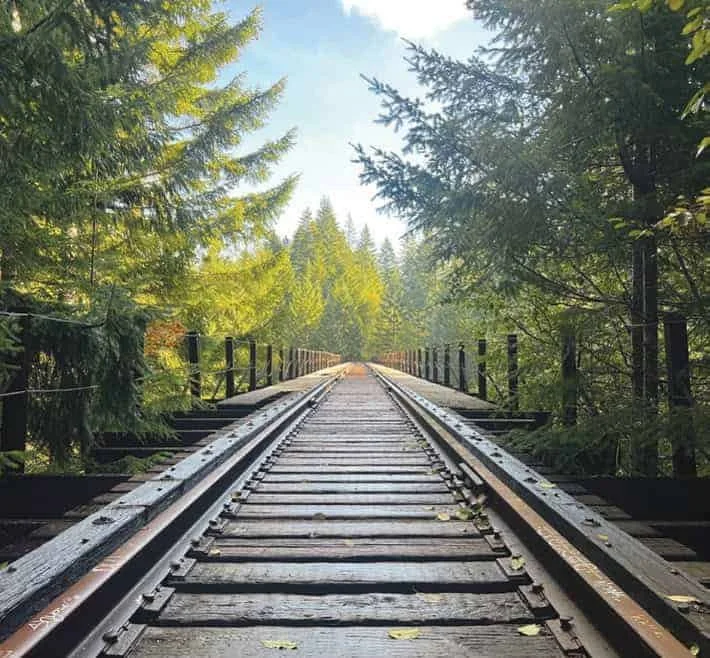
The trail from Tillamook to outside Banks would wind over old-growth forest, ten railroad tunnels and more than seventy-two trestles once completed.
The Salmonberry promises an unprecedented opportunity for exploration in the Coast Range. Beginning outside Banks, the route snakes along the Salmonberry and Nehalem rivers through old-growth forest and canyons, cuts west to Wheeler and ends in Tillamook. The route offers a time capsule that mixes adventure with natural and human history. It weaves through ten mossy railroad tunnels and more than seventy-two trestles standing up to 170 feet high, among trees and above treetops.